How to Make a Flea Trap: A Simple Night-Light and Soapy-Water Method
If you have dogs, cats, or other pets in your home, discovering fleas can quickly become frustrating. Adult fleas are tiny, fast-moving insects capable of jumping considerable distances, and once they begin reproducing, what appears to be a small problem can develop into a much larger infestation.
One reason a simple homemade flea trap can work is that adult fleas respond to light, movement, and vibrations in their environment. Adult cat fleas can orient toward light, while movement and vibration can stimulate fleas to emerge from their protective pupal cocoons and become active as they search for a host. University of Florida Extension specifically notes that adults are stimulated to emerge by vibration and that light traps placed where pets frequently spend time may collect newly emerged fleas.
That behavior gives pet owners a surprisingly simple way to monitor—and capture—adult fleas using nothing more complicated than a night light, a shallow pie pan, water, and dish soap.
The basic idea is simple:
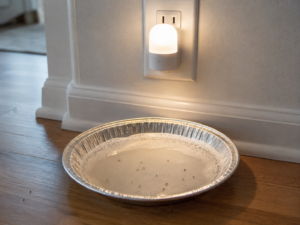
Plug a night light into a wall outlet and place a shallow pie pan containing lightly soapy water on the floor underneath the light. During the night, adult fleas attracted toward the illuminated area can jump toward the light, land in the soapy water, and become trapped.
This homemade flea trap is inexpensive, does not require spraying pesticides into the room, and can be particularly useful for identifying areas of flea activity.
However, there is one very important limitation every pet owner should understand:
A flea trap is a monitoring and supplemental control tool. It should not be considered a complete treatment for an established flea infestation.
Fleas have four life stages—egg, larva, pupa, and adult—and the trap primarily targets active adult fleas.
Why Fleas Can Become a Problem So Quickly
The flea most commonly associated with cats and dogs is the cat flea (Ctenocephalides felis). Despite its name, the cat flea commonly feeds on both cats and dogs.
One of the most important facts for pet owners to understand is just how rapidly fleas can reproduce.
According to the University of California Statewide Integrated Pest Management Program, a female cat flea can lay approximately 20 to 50 eggs every day.
Those eggs do not normally remain permanently attached to your pet. They readily fall from the animal into the surrounding environment, including:
- Carpeting
- Rugs
- Pet bedding
- Upholstered furniture
- Cracks along floors
- Areas underneath furniture
- Baseboards
- Kennels
- Pet resting areas
The eggs eventually hatch into larvae. The larvae feed and develop before producing protective cocoons and entering the pupal stage. Under suitable conditions, the entire flea life cycle can progress surprisingly quickly.
This explains why killing a few adult fleas on your dog or cat does not necessarily solve the problem. A significant portion of the developing flea population may already be somewhere in the home.
How Light and Vibration Help Fleas Find a Host
Fleas are specialized parasites. Their survival depends upon locating animals—or sometimes people—from which they can obtain a blood meal.
Several environmental signals help them determine when a potential host is nearby.
Movement, warmth, vibration, and other host-associated signals can stimulate adult fleas waiting inside pupal cocoons to emerge. The CDC notes that adult fleas can remain inside their cocoons until signs such as movement or body heat indicate that a host may be available.
Vibration can be particularly important. Walking across a floor, pets moving around a room, and even vacuuming can stimulate flea activity. University of Minnesota Extension notes that the movement and vibrations created by vacuuming can help stimulate adults to emerge from cocoons.
Adult fleas can also respond to light.
Research into flea attraction has demonstrated that illuminated traps can attract and capture fleas, and University of Florida Extension recommends light traps as a possible way of collecting newly emerged fleas around areas frequently occupied by pets.
That is the principle behind this homemade trap.
Homemade Flea Trap: What You Need
You probably already have most of the supplies.
Materials
You will need:
- One plug-in night light
- One shallow pie pan or similar shallow dish
- Warm or room-temperature water
- A small amount of liquid dish soap
- A safe wall outlet near an area where flea activity is suspected
A disposable aluminum pie pan works particularly well because it is inexpensive, shallow, and wide enough to provide a reasonable trapping surface.
A shallow plastic container can also work, although it should be heavy enough that pets cannot easily move or overturn it.

Figure 1. A simple plug-in night light can provide the light source for a homemade flea monitoring trap. Image credit: AI-generated by OpenAI for this article.
Step 1: Choose the Right Location
Location can make a major difference.
Do not automatically place the trap in the center of the largest room. Instead, concentrate on places where your pets regularly spend time.
Good locations include:
- Beside a pet bed
- Near a dog crate
- Near a cat sleeping area
- Along a wall beside carpeting
- Near upholstered furniture where pets sleep
- Near baseboards
- Near rugs
- In rooms where you have noticed fleas jumping
UC IPM recommends concentrating flea-control efforts around locations where pets rest because flea populations tend to be highest in those areas.
If you have multiple rooms showing flea activity, consider moving the trap from room to room over several nights or making several traps.
Step 2: Plug In the Night Light
Plug a standard night light into an outlet close to the floor.
The goal is to create a relatively small illuminated area directly above the trapping pan.
A night light works well because it:
- Uses very little electricity
- Can remain on overnight
- Produces enough light to provide an attraction point
- Does not require balancing a lamp over a container of water
- Keeps the electrical portion of the trap safely above the floor
For safety, never place an extension cord, lamp cord, electrical connector, or other electrical device where it could contact the water.
The night light should remain securely plugged into the outlet while the pan stays completely on the floor.
Step 3: Fill the Pie Pan With Water
Place approximately enough water in the pie pan to create a shallow pool.
You do not need to fill the entire pan.
Generally, ½ to 1 inch of water is plenty.
Keeping the water shallow reduces the amount of liquid on the floor while still providing enough surface area for the trap to work.
Step 4: Add Dish Soap
Add a small amount of liquid dish soap to the water.
You do not need to create a pan full of foam.
A small squirt or several drops distributed through the water is normally sufficient.
The soap changes the surface characteristics of the water so that fleas landing on it are less able to remain supported at the surface and escape.
Cornell Integrated Pest Management specifically describes a homemade flea monitoring trap using a light positioned over a pan of soapy water.
Stir the water gently so the soap is distributed throughout the pan.
Step 5: Place the Pan Directly Under the Night Light
Position the pie pan on the floor underneath the glowing night light.
The light should illuminate the surface of the water.
The finished setup should look like this:

Figure 2. Completed homemade flea trap: a shallow pie pan containing lightly soapy water positioned underneath a plug-in night light. Image credit: AI-generated by OpenAI for this article.
The setup does not need to be complicated.
Night light + shallow pan + water + dish soap = a basic homemade flea trap.
Step 6: Turn Off Other Lights
The flea trap generally works best at night when the surrounding room is dark.
Turn off unnecessary lamps, televisions, decorative lights, and other bright light sources.
The night light should ideally become one of the most noticeable sources of illumination near floor level.
Do not sacrifice safety to make the room completely dark. Hallway lights or other necessary household lighting can remain on.
Step 7: Leave the Trap Overnight
Allow the trap to remain in place overnight.
During periods when adult fleas are active, some may move or jump toward the illuminated area and fall into the soapy water.
The following morning, inspect the water carefully.
Adult fleas are very small and generally appear as dark reddish-brown or black specks.
If you find fleas in the trap, you have confirmed adult flea activity in or around that location.
Step 8: Empty and Reset the Trap
Dispose of the water and trapped insects.
Wash the pan and refill it with fresh water and dish soap.
During an active flea problem, resetting the trap each evening makes it easier to compare flea activity from one night to the next.
For example:
Night 1: 15 fleas
Night 2: 10 fleas
Night 3: 6 fleas
Night 4: 3 fleas
Night 5: 1 flea
A declining number may suggest that your overall flea-control program is reducing adult flea activity.
However, do not assume the infestation is gone simply because the trap is empty for one night.
Why the Trap Is Especially Useful for Monitoring
One of the biggest benefits of the homemade night-light flea trap is not simply killing fleas.
It is monitoring.
Professional pest management often relies on monitoring to determine where pests are active and whether control measures are working. EPA’s integrated pest management principles emphasize pest identification and monitoring as important parts of deciding how to manage a pest problem.
You can use homemade flea traps in different rooms to answer questions such as:
- Which bedroom has the most flea activity?
- Are fleas concentrated around the dog’s sleeping area?
- Are fleas emerging near a particular couch?
- Is flea activity decreasing after treatment?
- Are fleas still emerging several days after cleaning?
- Has a previously treated room become active again?
That makes the trap particularly valuable after a flea treatment.
The Biggest Challenge: The Trap Does Not Reach the Entire Flea Life Cycle
This is where many homeowners make a mistake.
They see dozens of fleas in the water and conclude that the trap will eventually eliminate every flea in the house.
Unfortunately, flea biology makes the situation more complicated.
The flea life cycle consists of:
Egg → Larva → Pupa → Adult
The night-light trap primarily catches adult fleas.
It does not reliably remove eggs hidden in carpeting.
It does not remove every larva feeding beneath furniture.
It does not penetrate pupal cocoons.
The pupal stage is particularly difficult because the cocoon protects the developing flea. The CDC notes that cocoons can protect flea pupae from environmental conditions and insecticides or repellents until adults are ready to emerge.
This is why fleas sometimes seem to disappear and then suddenly return.
The fleas appearing today may have developed from eggs laid days or weeks earlier.
Combine the Trap With Vacuuming
One of the best things a pet owner can do during a flea infestation is vacuum regularly.
The EPA currently recommends vacuuming daily during initial flea control and paying special attention to:
- Carpets
- Cushioned furniture
- Floor cracks and crevices
- Baseboards
- Basements
- Areas where pets spend time.
Vacuuming provides several benefits.
It removes some flea eggs, larvae, adults, flea debris, and organic material from the environment.
It also creates movement and vibration.
Those vibrations can encourage adult fleas to emerge from pupal cocoons, making them vulnerable to vacuuming, pet treatments, professional treatments, and monitoring traps.
In other words, seeing a few fleas after vacuuming does not necessarily mean the vacuuming “made the infestation worse.”
It may mean that dormant fleas were stimulated to emerge.
Wash Pet Bedding
Your pet’s favorite sleeping location can become a concentrated flea-development area.
Wash pet bedding regularly.
EPA recommends washing bedding used by pets in hot, soapy water as part of household flea management.
Also consider washing:
- Blankets
- Removable furniture covers
- Throw rugs
- Crate pads
- Pet pillows
- Washable pet toys
Always follow the manufacturer’s laundering instructions.
Treat the Pets Too
A flea trap on the floor cannot replace appropriate flea prevention or treatment for your animals.
Adult fleas spend much of their time feeding and reproducing on animal hosts.
If fleas are present, all pets in the home should be considered as part of the flea-control program.
The CDC recommends treating pets and advises owners to speak with a veterinarian about selecting an appropriate flea-control product.
This is particularly important because products appropriate for one animal may not be appropriate for another.
Never assume a flea product labeled for dogs can be safely used on cats.
Follow veterinary advice and product-label directions.
Safety Around Pets and Children
Although this homemade flea trap is simple, it still involves an open container of soapy water sitting on the floor.
Place it somewhere pets and children cannot easily:
- Drink from it
- Step into it
- Knock it over
- Play with the pan
- Pull or damage the night light
Do not add pesticides, insecticides, bleach, essential oils, solvents, or other chemicals to the trap.
Plain water with a small amount of ordinary dish soap is all that is necessary for this monitoring method.
Never place water where it can contact the electrical outlet or night light.
If your pet is likely to disturb the pan, move the trap to a protected location at night or use another flea-monitoring method.
Benefits of a Homemade Flea Trap
For pet owners, this trap offers several advantages.
Low Cost
Most households already have dish soap and a shallow pan.
A basic night light is inexpensive and reusable.
Easy to Build
There are no complicated components, chemicals, or construction steps.
It can usually be assembled within a few minutes.
Useful for Monitoring
The trap can help identify rooms with adult flea activity and track changes during a treatment program.
Minimal Chemical Exposure
The trap itself does not require spraying an insecticide into the living area.
That makes it useful as one component of an integrated flea-management program.
Works While You Sleep
Once positioned correctly, the trap can operate overnight without additional attention.
Limitations of Homemade Flea Traps
Despite these advantages, homemade flea traps have limitations.
Light traps may capture fleas that have emerged into the environment, but University of Florida Extension cautions that they are unlikely to draw fleas away from a pet that is already serving as a host.
Similarly, Iowa State University Extension notes that light-based flea traps can capture fleas but questions whether trapping alone can eliminate an infestation.
Therefore, think of the trap as part of a larger strategy rather than a stand-alone cure.
A Better Flea-Control Strategy
For a home with pets, a practical integrated approach looks like this:
1. Treat every pet appropriately.
Work with your veterinarian or use properly labeled flea-control products according to directions.
2. Vacuum frequently.
Concentrate on carpeting, furniture, baseboards, floor cracks, and pet resting locations.
3. Wash pet bedding.
Regular laundering helps remove flea life stages and organic debris from concentrated pet areas.
4. Use homemade flea traps for monitoring.
Place them near locations where animals spend the most time.
5. Continue monitoring.
Do not stop simply because you no longer see adult fleas on your pet.
6. Consider professional flea control when infestations persist.
Moderate or severe infestations can be difficult to eliminate because of the flea’s extended life cycle. The CDC notes that controlling moderate to severe flea infestations can take months and requires addressing sanitation, pets, the home, and follow-up.
Future Trends in Flea Trapping
The basic light trap is simple, but flea-monitoring technology continues to evolve.
Researchers have examined how different types of light affect flea attraction. One published study comparing commercial flea traps found that a trap using intermittent light captured substantially more fleas than several traps using continuous light under the conditions tested.
That research suggests future flea-monitoring devices may increasingly use:
- Optimized LED wavelengths
- Intermittent or pulsing light patterns
- Heat cues
- Motion or vibration simulation
- Replaceable adhesive capture surfaces
- Electronic flea-counting sensors
- Smart-home monitoring technology
The goal will likely remain the same: imitate some of the environmental signals fleas associate with a nearby host.
For homeowners, however, sophisticated technology is not always necessary.
A simple night light positioned above a shallow pan of soapy water can still provide useful information about flea activity.
When to Call a Pest Control Professional
Occasionally finding one or two fleas may be manageable with pet treatment, cleaning, vacuuming, and monitoring.
Professional flea treatment should be considered when:
- Fleas are repeatedly biting people.
- Large numbers appear every day.
- Several rooms are infested.
- Fleas continue despite treating the pets.
- Fleas return shortly after treatment.
- Rental or vacant properties have large numbers of emerging fleas.
- You cannot identify where the infestation is coming from.
- Flea activity remains high despite several weeks of proper sanitation and pet treatment.
A professional pest-control inspection can help identify heavily infested areas and determine whether additional treatment is necessary.
Final Thoughts: A Very Simple Flea Trap That Really Can Be Useful
A homemade flea trap does not need to be complicated.
Plug a night light into a low wall outlet.
Place a shallow pie pan underneath it.
Add water and a small amount of dish soap.
Leave the trap in place overnight.
Then inspect the pan the following morning.
The trap takes advantage of flea behavior by placing a trapping surface near a light source that can attract active adult fleas. Movement and vibration in the home can also stimulate adults to emerge and search for hosts.
Most importantly, remember what those trapped fleas may represent.
A female cat flea can produce approximately 20 to 50 eggs per day, and those eggs can fall into the environment where additional generations develop.
That is why the best flea-control program combines monitoring, pet treatment, vacuuming, washing pet bedding, environmental management, and professional treatment when necessary.
The night-light and soapy-water trap is not a replacement for those measures.
It is something equally valuable:
A simple, inexpensive tool that almost anyone can make to detect adult fleas, reduce some flea activity, and help determine whether their overall flea-control program is working.
Image Attribution
Figure 1 – Night light plugged into an outlet: AI-generated by OpenAI specifically for this article.
Figure 2 – Pie pan containing lightly soapy water beneath a night light: AI-generated by OpenAI specifically for this article.
References
Information in this article was supported by guidance and research from the U.S. Centers for Disease Control and Prevention, U.S. Environmental Protection Agency, University of California Statewide Integrated Pest Management Program, University of Florida IFAS Extension, Cornell Integrated Pest Management, University of Minnesota Extension, Purdue Extension, and published research examining flea attraction to illuminated traps.